When telling stops working
It’s Monday. Jeremy has speech therapy at 8:15, which means we have to be out the door by latest 8:00. That’s the deadline. Everything before it’s logistics.
This is the morning I started counting.
The bed-making struggle, again. The “come to breakfast dressed” rule, again. The “I’ll serve once you’re ready” bargain, again. Then Jeremy at the table without socks. Then Jeremy at the door without socks. Then the chant: “please put your socks on, if you don’t put socks we can’t put shoes, Jeremy we need to leave.”
“Can you put them on for me, daddy?”
Isaac, in parallel: “Do you know where my folder is?” He didn’t put it away yesterday. He won’t put it away tomorrow either.
We made it. We always make it. But by 8:30, in the quiet, I noticed the same six things came out of my mouth this morning that came out last Monday. And the Monday before.
The reason isn’t that the kids weren’t listening. The reason is more uncomfortable: the more I told them, the less they were learning to do any of it without me.
There’s a name for this in developmental psychology. It’s called prompt dependency, or in the broader scaffolding literature, the failure of fading. The principle is simple. When an adult cue helps a child complete a task, the child completes the task. But if the cue stays the same, day after day, the cue stops being a help. It becomes the thing that has to happen for the task to happen at all. The child hasn’t learned to put on socks. They’ve learned to wait until someone says “put on your socks.”
Researchers studying parental scaffolding (the supports that help children grow into harder cognitive tasks) are clear: the supports are supposed to fade. When they don’t, autonomy doesn’t develop. What looks like a kid who “doesn’t listen” is often a kid who’s been trained, by accident, to wait.
This is the part that hit me. I wasn’t building autonomy by repeating myself. I was building dependency on the repeating.
Most routine apps for families are built for the parent holding the phone. They render as checklists, dashboards, status indicators. The kid is a state to be managed, not a person who’s looking at the screen.
Cresci flips the camera.
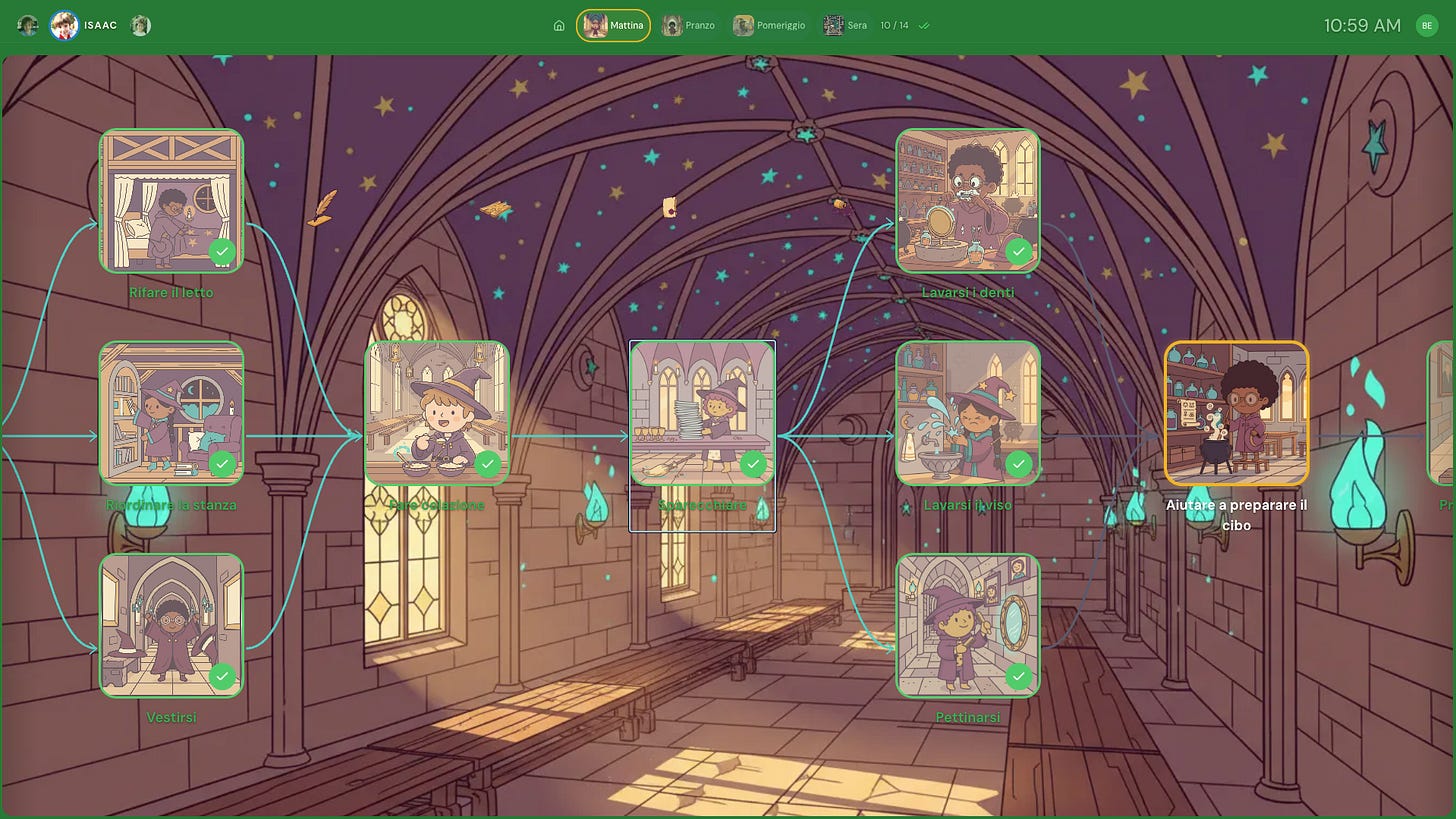
When Jeremy opens it on Monday, he doesn’t see “Jeremy’s compliance: 30%”. He sees his morning, drawn for him. Make the bed. Dress up. Put your socks on. Then breakfast. Then brush teeth, wash hands, wash face. The order is his order. The view belongs to him.
Isaac’s screen is similar but longer. He’s older, so his routine includes things Jeremy isn’t doing yet: clear the table, prepare your backpack, tidy your room. Each kid sees their own day, scaled to their age and responsibilities.
This is the frame everything else builds on. If the routine is rendered for the parent, the parent stays the operator. The kid stays the operated-on. The whole architecture, no matter how cleanly designed, ends up reinforcing the prompt-dependency dynamic. The kid waits for the parent to say “now this”. Rinse and repeat.
If the routine is rendered for the kid, something different becomes possible. The kid can see what’s coming. They can see what they just did. They have a picture of their own day before anyone tells them what to do.
That’s not a feature. It’s a stance.
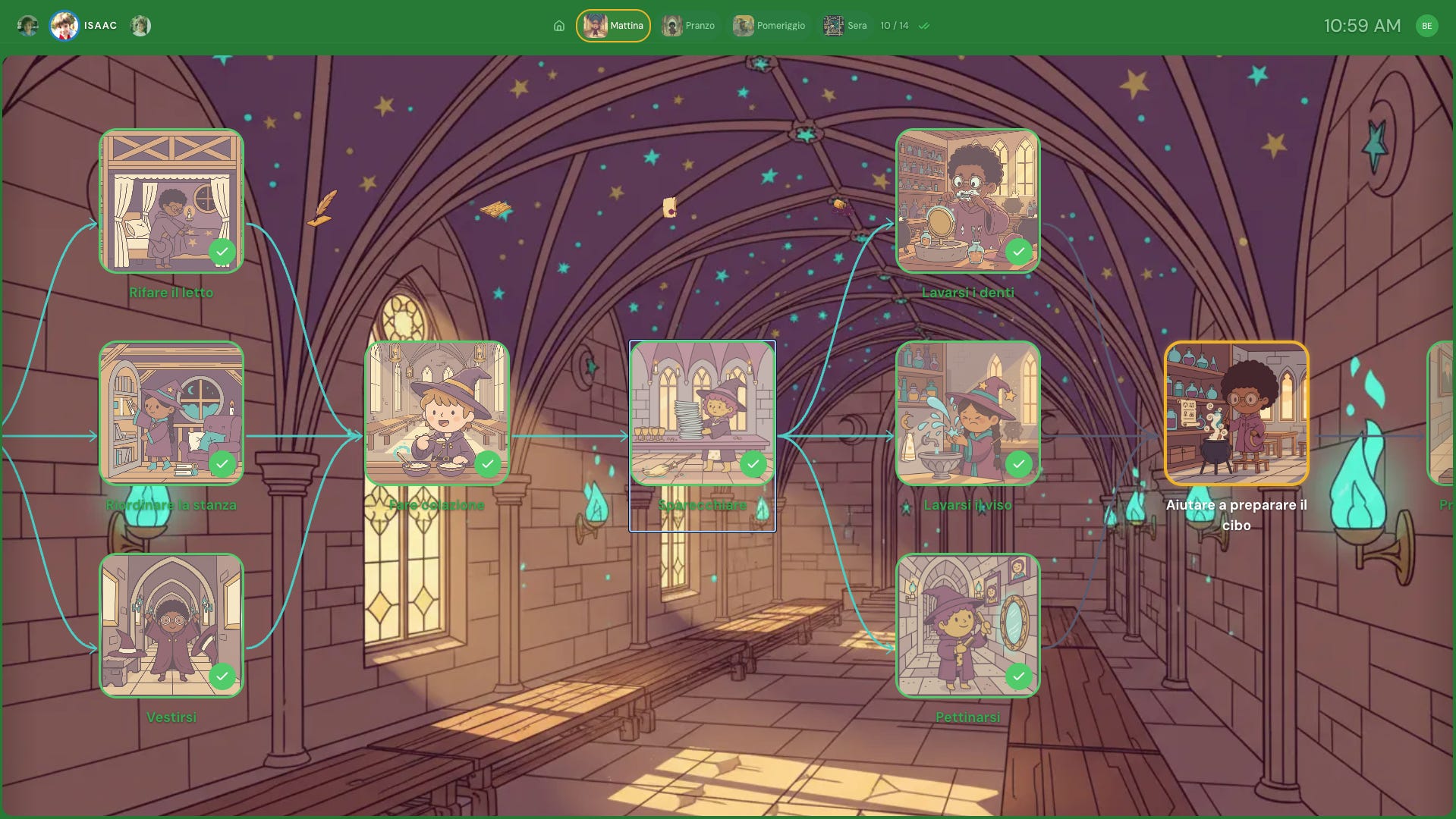
The view belongs to the kid. So does the next step.
When Jeremy opens Cresci on Monday morning, the morning routine is already highlighted. The time context does that work. Cresci knows it’s morning, and surfaces what’s relevant. From there, every transition is his.
Make the bed. Tap. Check. Dress up. Tap. Check. Put your socks on. Tap. Check.
That’s the whole interaction. No timer pushing him along. No parent confirming. No animation, no points, no fireworks. Just a quiet checkmark. He looks at the next task and decides when he’s ready.
In the prompt-fading literature, this is called a time delay: waiting after a natural cue to let the child respond on their own. Cresci’s natural cue is the routine being open. The time delay is built in.
The obvious objection: what if he marks something done that he didn’t actually do? It happens. We didn’t build verification, because verification is the parent staying in the loop. The whole point is to step out of the loop. Two things end up handling it. Reality is the audit. If Jeremy says he made the bed and didn’t, the bed is unmade. Conversations happen, but they happen later, not in the middle of the morning. And kids treated as trustworthy mostly become trustworthy. Slowly. Imperfectly. But the direction is the one we want.
The reward is a checkmark, not a celebration. The parent’s job becomes presence, not enforcement.
Real life doesn’t follow a routine.
Some mornings Jeremy is sick. Some weekends we’re traveling. Some days Isaac wakes up at 9am because Saturday. Some days nothing gets tapped at all, because that’s how that morning went.
Cresci doesn’t fight any of this. Routines can be set to weekdays only, weekends only, or every day. Skipping a step doesn’t trigger anything. Skipping a whole morning doesn’t either. There are no streaks to break, no badges withheld, no nag-screen at the end of the week.
What Cresci tracks instead is consistency over time, and it surfaces it gently. Each routine sits inside a themed scene. The morning routine in the island theme is a beach. The beach has 30 props: birds, surf, crabs, things at the edges. As kids tap their tasks consistently, more props appear. Slowly. Quietly. The beach gets more alive.
If Jeremy missed a morning, the beach doesn’t punish him. It just stays where it is until next time. The signal is “you’ve been showing up,” not “you broke your streak yesterday.” Habits are built over time, not in one morning.
What we do with the data: a weekly review with the kids. Not a report card. A conversation.
It’s still Monday morning at our house. There are still moments where Jeremy needs to put his socks on, where Isaac’s folder is somewhere it shouldn’t be. Cresci hasn’t made our mornings perfect.
What’s changed is what comes out of my mouth. The chant is shorter. Some days it doesn’t happen at all. The kids open their morning, see what’s theirs, and start.
Habits are built over time. Telling builds the opposite.
If this resonates, I’d love to hear from you. Reply, write back, tell me what your Monday looked like.
https://cresci.kids/
Thanks for reading Cresci.kids! Subscribe for free to receive new posts and support my work.