The thing I stopped saying
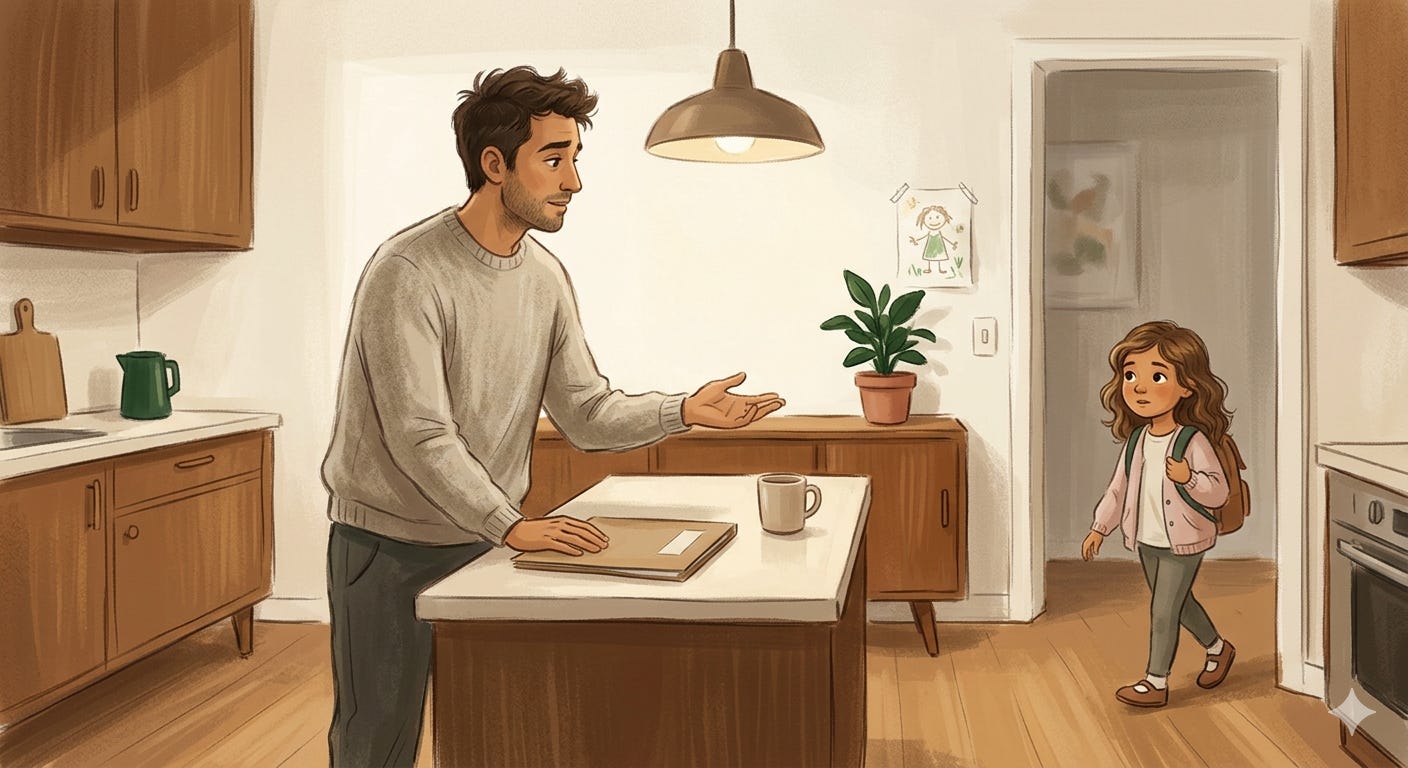
For about a year, one of the first things I said to Margot every morning was the same sentence.
Sometimes I said it twice.
Did you take your school folder.
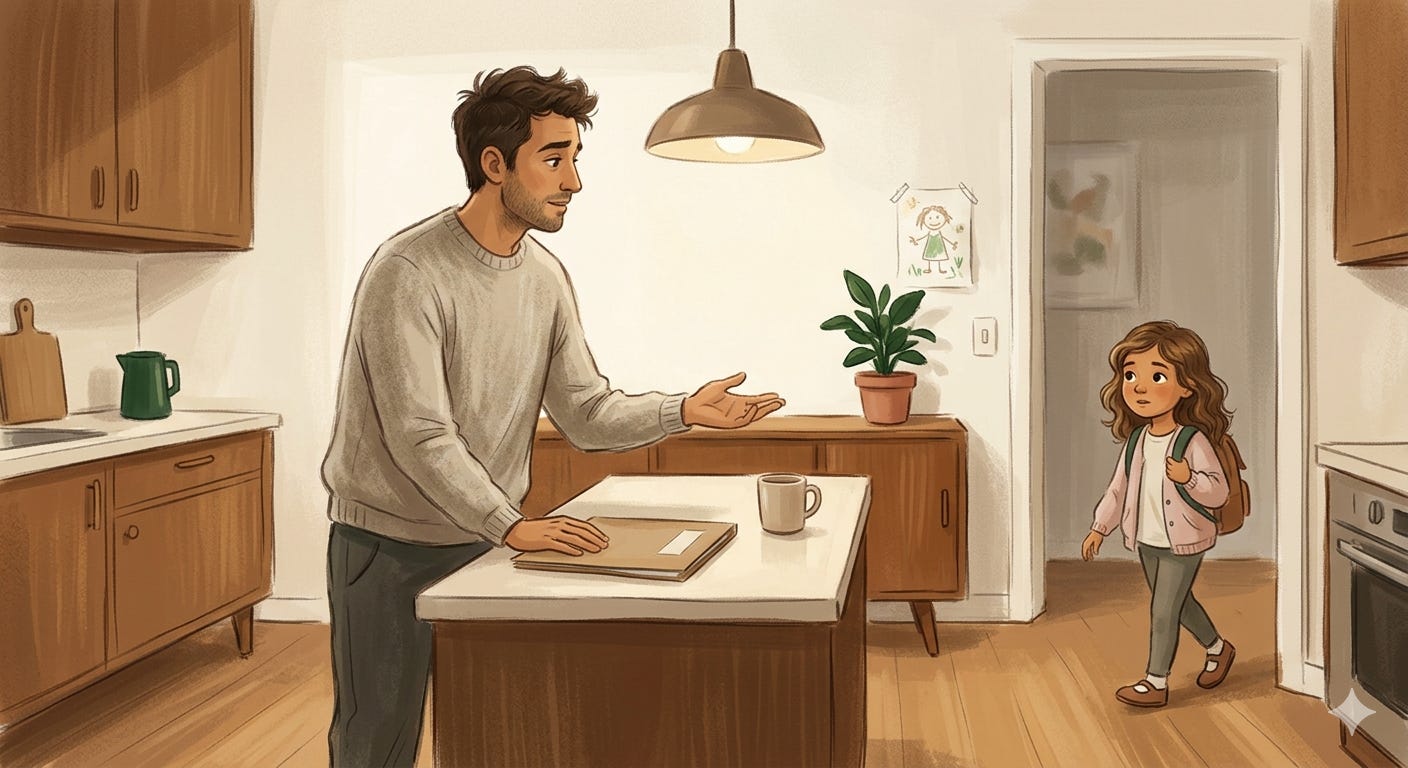
It wasn’t a question. The shape was a question but everyone in the kitchen knew it was a reminder wearing the costume of one. She would say yes, or she would walk back to the hallway, or she would pretend not to hear and I would say it again, slightly slower, slightly louder. Then we’d go to school.
I don’t know exactly how many mornings that was. Two hundred… maybe?. Probably more. Long enough that my own voice, saying that one sentence, became part of the background sound of the house, the way a clock you’ve stopped noticing keeps ticking.
Then one morning I forgot to say it. Not a decision, not a quiet experiment, I simply forgot. I walked past her in the hallway thinking about something else, the sentence didn’t arrive, and we went to school. I didn’t notice until much later in the day. Just an absence where a phrase used to be.
That afternoon she came home, sat down at the kitchen table, and said, slightly quieter than her usual voice, that the teacher had asked for the signed papers and she hadn’t had them. She wasn’t crying, wasn’t embarrassed in the loud way kids can be, just diminished by half a notch. The teacher had asked. She hadn’t had it. Now she was telling me.
I felt two things at once. The first was a small, quiet smile, not at her, not because she’d failed, but at the timing. A year of asking, and the one morning I didn’t, it backfired. The second was guilt, and it surprised me by not being the guilt I would have predicted. It wasn’t the guilt of having missed one reminder on one morning. It was the guilt of realising what I had built. For a year I had been the entire system. One tired adult, one sentence, every morning. A system that depends on a tired adult remembering one sentence isn’t a system. It’s a streak. And streaks end.
How much room a small kid should have to run her own life is something I’ve been turning over for a long time, well before this particular morning. The kitchen-table conversation didn’t introduce the question. It pressed on a question I was already carrying. That week I went back to it with more urgency. I started googling “kid autonomy, what six-year-olds can manage on their own” and reading whatever came back. Somewhere a few articles deep, I ran into a few interesting articles, and youtube videos.
The word I kept circling was shitsuke. It usually gets translated as discipline, which is the wrong shape in English. It’s closer to the cultivation of habit through structure, not through command. The principle, as I understood it, is that the adult is not the system. The structure is the system. The habit lives in the ritual, the environment, the small daily acts the child owns.
You see it in ordinary places. First-graders in Japan pack their own backpack, or randoseru in Japanese. Classrooms have a stretch at the end of the day where the children, not a cleaner, wipe down the desks and sweep the floor. Six-year-olds walk themselves to school. The adults model the thing, carefully, and then they step back. The remembering is held by the routine, by the bag by the door, by the broom in the corner. Not by a parent’s voice in a hallway.
I’m not Japanese. We don’t have a village around us. Margot’s school doesn’t expect a seven-year-old to manage her own folder, and the street outside our door isn’t a street I’d send her down alone. We were the system because no one else was going to be. So we did a small version of shitsuke we could actually do inside our own house. We put a whiteboard at the entrance.
It’s a large whiteboard, hung in the corridor that leads to the front door, the last surface anyone passes on the way out of the house. Most of the time it’s a place where the kids draw, scribble names, play. In the morning, before we leave, we do small exercises on it together. And down in one corner, in the same handwriting as everything else, we keep the short list of things we shouldn’t forget: today’s short-term goals, the school breakfast meal, the school folder.
It still slips sometimes. Less. Much less. A while ago we were walking the dog and I asked Margot, half curious, half checking, whether she actually looked at the board in the mornings. Whether the reminders were doing anything for her, or whether they were mostly for me. She thought about it for a second and said, more cheerful than I expected, these really help me remember the things I couldn’t before. I didn’t say anything to that. I wrote it down later, at home.
That was the moment I understood the whiteboard had stopped being mine.
I can stop saying the sentence now because the question is being held somewhere other than in my voice. Silence, when nothing has replaced you, isn’t a design decision. It’s just absence, and absence is what cost her the signed papers.
The morning Margot forgot the papers was, in a small way, the first morning I learned the difference.
Further reading
If you want to look into this further, two starting points at different depths:
Selena Hoy, Why Are Little Kids in Japan So Independent?
Bloomberg/CityLab, 2015. A short, observational piece on six-year-olds in Tokyo running errands and commuting alone, and the structural reasons it works.